Introduction

Background

The Township of Edwardsburgh Cardinal is conducting a review of its Zoning By-Law No. 2012/35. This review is mandated by the Province, which requires zoning by-laws to be updated within three years after approval of an official plan update. The latest Township Official Plan was approved in February 2020. The Community Development Committee started the review in July 2020 and expects that the process will take about a year. The "Share Your Feedback" page on the Township's website provides an excellent summary of the review process and the relationship between official plans and zoning by-laws. Detailed information on land use, including the Planning Act, Official Plans, Zoning By-Laws and more, can be found in The Citizen's Guide to Land Use Planning online or pdf.

Purpose of this Website

The purpose of this website is to facilitate public participation in the review through discussion of the proposed changes. The focus here is primarily on those changes affecting properties in the Limited Services Residential (RLS) zone and principally Tuttle Point. This website is not a comprehensive review of the entire revision.
This is a private endeavour. The discussion and recommendations are the opinions of the author. But it is hoped that the effort can be collaborative, reflecting a range, if not a consensus, of opinions. Suggestions and comments are welcome and will, to the extent possible, be reflected in updates to the site.

This website is based on the October 2020 version of the draft by-law, which is available as an attachment to the agenda and minutes of the Nov 2, 2020 meeting of the Community Development Committee. The Committee continues its review and to direct changes. Any subsequent drafts will be incorporated into this site if they are available before the formal draft for public review is published.

Structure of this Website

This website contains four sections:

The sections are essentially self-contained, but a fuller understanding may be gained by reading them in sequence.

Summary and Recommendations

Summary

  1. The draft zoning by-law has substantial changes to layout and format and a number of significant changes in content. The tables of contents of the draft and current documents are shown in this table.
  2. There are many changes to definitions, comprising additions, deletions, reorganization and revised wording . Definitions are fundamental for interpreting the by-law, and decisions on the appropriate use or development of a property will depend on this interpretation. It is beyond the scope of this web page to address every change. Specific definitions applicable to the RLS zone are discussed below. Readers are encouraged to review the definitions related to subjects of importance to them.
  3. Zoning changes related to RLS include:
    1. The number of lots zoned RLS is reduced from 300 to 129. The former RLS lots are assigned to the Rural (RU) zone.
    2. "Limited Services" is no longer defined in the by-law.
    3. A "Flood Plain Overlay Zone" (section 5.7.1) has been added to define areas in the flood plain where additional restrictions on use or development are applicable.
    4. The draft by-law is generally more restrictive in terms of land use and development as shown in the table 1.
    Table 1 - Proposed By-Law Restriction Changes
    More Restrictions Fewer Restrictions
    1. Accessory use as a bed and breakfast
    2. Temporary accessory use of recreational vehicles
    3. Maximum shoreline occupancy
    4. Maximum lot coverage
    5. Maximum residence floor area
    6. Minimum lot frontage
    7. Minimum side yard
    1. Accessory use as a home business
    2. Accessory use as a group home
    3. Minimum separation for accessory buildings and structures
    4. Front, exterior side and rear yard setbacks.
  4. A common issue with these changes, particularly the more restrictive, is that the rationale is not clear. There is no indication as to how these particular provisions will best contribute to achieving the Township's Official Plan vision and guiding principles. Without a link between means and objectives the by-law changes can appear arbitrary.
  5. The link between means and objectives is particularly vague for the RLS zone. What, for example, is the objective of reducing maximum lot coverage by 50% when a very similar lot next door and now zoned RU retains the current maximum? Why is the "maximum residence floor area" provision only applied to RLS?
  6. In principle, some provisions, such as "water setback", have relatively clear objectives. In practice, however, the realities of lot location and existing waterside development may conflict with these larger objectives. The practical means of balancing the desires of the property owner and the needs of the environment should be more precisely defined.

Recommendations

Recommendations are summarized in table 2. The subject of each recommendation is a link to the detailed discussion.

Table 2 - Recommendations
Section Subject Recommendation
(N/A) Provision of Public Services
  1. In accordance with the Official Plan, the Township should promulgate any limitations in providing public services (fire, police, ambulance, etc.) on private roads.
  2. The zoning by-law or other appropriate document should specify the design and maintenance standards for private roads suitable for public services access.
Definitions 2 Lot Coverage The Community Development Committee should explain the rationale for including swimming pools in lot area calculations and the aesthetic and practical objectives of the proposed limit.
2 Limited Services The revised zoning by-law should include:
  1. a definition for "limited services"; and
  2. a summary of what distinguishes RLS from other residential zones (e.g. properties accessed by private road)
General Provisions 3.1 Accessory Building Height Provide the rationale for reducing maximum building height.
3.1 Accessory Building Stories Provide the rationale for limiting accessory buildings to one storey.
3.11.6 Non-Complying Yards Change the wording of section 3.11.6 to confirm vesting of non-complying minimum yards during future development.
3.12.3 Recreational Vehicles Occupancy on Seasonal or Temporary Basis Investigate best practices in other communities and seek public input.
3.22 Recreational Vehicle Temporary Use During Construction
  1. Reconsider the sewage handling and siting objectives for temporary occupancy of recreational vehicles during construction
  2. Specify the permitting process, including fees, for temporary use during construction.
3.25 Minimum Water Setback Provide an exception to the water setback provision for Tuttle Point.
Zone Provisions 6.5.1 Second Dwelling Resolve the apparent contradiction between section 4.8 and section 6.5 on second dwellings and dwelling units.
6.5.2 RLS Minimum Lot Area Reduce the minimum lot size to 0.4 ha or as existing on the applicable reference plan.
6.5.2 Minimum Frontage Retain the current 30 m. minimum frontage.
6.5.2 Minimum Yards Set the yard minimums to the same as for the R1, with private services, and RH zones.
6.5.2 Maximum Building Height Provide a rationale for the proposed height change to principal use buildings.
6.5.2 Maximum Lot Coverage Retain, as a minimum, the 20% maximum lot coverage
6.5.2 Floor Space Index Remove the "Floor Space Index" restriction.

Limited Services Residential (RLS) Zone

Introduction

Limited Services Residential (RLS) is one of five residential zones in the Township. It comprises areas where "there is no intent by Council to maintain roads. Other municipal services may not be available or may be restricted, and there is no intent by Council to upgrade such levels of service." (Zoning By-law No. 2012-35, section 6.4)

The current by-law includes four RLS exception zones (RLS-1 to RLS-4) which specify special case exceptions to the main permitted use and other zoning requirements. Exception zones are normally the result of zoning by-law amendments made by separate by-laws that address the special case.

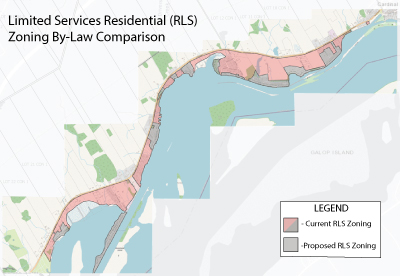
Currently, most of the lots located between County Road 2 and the St Lawrence River from Johnstown to Cardinal are zoned RLS as depicted in schedule D to the zoning by-law 2012-35. All of Tuttle Point is zoned RLS.

Proposed Changes to RLS Zone (October 2020)

The October 2020 draft of the revised zoning by-law has changes to all elements of the current zone and significantly reduces the number of lots zoned RLS. The four exception zones are integrated into the main zone.

Lots Zoned RLS

The current and proposed lots zoned RLS are plotted on a map based on the Leeds and Grenville Property Lookup. The map can be downloaded in PDF format by clicking on the RLS Zone Map image.

The proposed RLS zoning applies to properties along the St Lawrence River, south of County Road 2 that are accessed by private road. However, several properties with County Road 2 addresses and direct access to the public road are also zoned RLS. As discussed in Table 4 below, this combination of properties on private roads and public roads complicates understanding of what RLS zoning means.

RLS Zone Properties
Private Roads in RLS Zones County Road 2 Properties in RLS Zones
  • Shoreline Road
  • Hilltop Road
  • Tuttle Point
  • Riddell Road
  • Riddell Road East
  • Gullymeade Road
  • Bay Lane
  • Moore Road
  • Empire Hanna Road
  • Gallop Canal Road
  • Vic Woodland Road
  • Gaylord Road
  • Village Edge Road

The official plan establishes seven land use "Policy Areas". These policy areas define the specific land use objectives and establish the criteria for policies such as lot size, residential density and land division. The proposed RLS zoning involves properties in two of these policy areas. Two of the properties, at 2411 and 2413 CR 2, are in the Settlement Policy Area (Official Plan section 3.2). The remainder are in the Rural Policy Area (Official Plan section 3.4).

Changes to Zoning Authorized Use and Other Provisions

The proposed changes to the RLS zone are shown in table 3 and are discussed in detail in table 4.

table 3 - RLS Zoning - Proposed Changes
ZONING BY-LAW 2012-35 ZONING BY-LAW PRELIMINARY DRAFT (OCTOBER 2020) COMMENT
6.4 LIMITED SERVICE RESIDENTIAL (RLS) 6.5 Limited Services Residential (RLS)  
In the Limited Services Residential zone, there is no intent by Council to maintain roads. Other municipal services may not be available or may be restricted, and there is no intent by Council to upgrade such levels of service.

No person shall use any land or erect, alter or use any building or structure in the Limited Service Residential (RLS) zone except in accordance with the following provisions:
DELETED RLS 1
(a) Permitted Uses 1. Permitted Uses RLS 2
Bed and Breakfast Establishment, fronting on a public road which is maintained year round DELETED RLS 3
Public Park DELETED RLS 4
Single detached dwelling, fronting on a public road which is maintained year round DELETED  
Single detached dwelling, fronting onto a private road single dwelling  
Tot lots DELETED RLS 5
A home based business or home industry as an accessory use to a permitted permanent dwelling on a public road DELETED RLS 6
Accessory uses to the foregoing. DELETED RLS 7
(b) Zone Requirements 2. Zone Provisions  
Minimum lot size for any dwelling: 1.0 ha (2.47 ac)
* If an engineering report, prepared by a qualified engineer licensed to practice in Ontario, demonstrates that private on-site sanitary services are environmentally sustainable on a smaller lot, the minimum lot size may be reduced to 4,000 sq.m.
Lot Area (minimum) 1.0 ha RLS 8
Minimum Lot Frontage 30 m (98.4 ft.) Lot Frontage (minimum) 45 m RLS 9
Minimum Yard Requirements: Yards (minimum) RLS 10
  Front Yard 10 m (32.8 ft.)   Front 7.5 m
  Rear Yard 15 m (49.2 ft.)   Rear 7.5 m
  Interior Side Yard 3 m (9.8 ft.)   Interior Side 6 m
  Exterior Side Yard 8 m ([26.2 ft.)   Exterior Side 7.5 m
Maximum Building Height:
Main Building 11 m (36.1 ft.)
Accessory Building 6 m (19.6 ft.)
Building Height (maximum) 10 m RLS 11
Maximum Lot Coverage 20% Lot Coverage (maximum) 10% RLS 12
  Floor Space Index (maximum) 10%
Maximum Number of Dwellings per Lot: 1 Dwellings per Lot (maximum) 1  
(c) Additional Provisions 3. Additional Provisions
[i] Guest Cottages
    A second dwelling in the form of a guest cottage shall not be permitted in the RLS zone.

  [ii] Apartment and Garden Suites
    Apartments in houses and garden suites shall not be permitted on lands zoned RLS unless the detached dwelling fronts onto a public road maintained year-round.
  1. General Provisions
    In accordance with Section 3 & 4 hereof.
  2. Secondary Dwellings
    Secondary Dwellings or Secondary Dwelling Units shall not be permitted.
(d) Exception Zones 4. Special Exception Zones
(The exception zones are not included in this summary because they do not apply directly to Tuttle Point. For information on these exception zones please refer to the zoning by-law section 6.4) (reserved)

Discussion of Proposed RLS Zoning Changes

table 4 - Comments on Proposed RLS Zoning Changes
SER COMMENTS RECOMMENDATIONS
RLS 1
RLS description
  1. "Limited Services" is not defined in the draft by-law. The Township Official Plan, section 5.3.19, states, "Where access to properties is provided by private roads, municipal services such as snow ploughing or road maintenance and improvement are neither available nor the responsibility of the Township." The lots zoned RLS in the draft by-law are generally accessed by private roads, and it can be assumed that that the RLS zone is intended to reflect the official plan. However as discussed above, several properties in the proposed RLS zones are accessed by public road. This discrepancy is not new - the current by-law includes properties fronting on public road in the RLS zone - but the existing definition is an attempt to characterize RLS even if it is not consistently applied.
  2. "Private Roads" are defined in the Edwardsburgh Cardinal Official Plan section 5.2 as "rights-of-way which provide access to two or more properties but which have not been assumed by the Township for maintenance purposes." (5.2.16)
  3. Section 5.3.17 of the Official Plan states that a right of way providing a shared driveway to two adjacent properties shall not be construed as creation of a private roads. This implies that two adajcent properties with a shared driveway off a public road should not be zoned RLS. The zoning by-law should make this clear.
  4. Section 5.3.19 of the Official Plan notes that where "access to properties is provided by private roads, municipal services such as snow plowing or road maintenance and improvement are neither available nor the responsibility of the Township. Additionally, in some cases other public services such as school busing and protection to persons/property from services including police, fire and ambulance may be unavailable or limited in nature. The Township shall attempt to recognize such limitations through the mechanisms of the Zoning By-law and/or municipal agreements." (emphasis added)
  5. There is no evident standard for determining whether a private road is suitable for public service access. Such a standard should be established to inform owners of private roads of the road standards necessary to ensure public services are available.
  1. The revised zoning by-law should include:
    1. a definition for "limited services";
    2. a summary of what distinguishes RLS from other residential zones (e.g. properties accessed by private road); and
    3. the design and maintenance standards for private roads suitable for public services access.
  2. The status of two properties sharing a driveway accessed from a public road should be explained.
  3. In accordance with the official plan, the Township should promulgate any limitations in providing public services on private roads.
RLS 2
permitted uses
Permission for or restrictions on the uses deleted in the draft bylaw amendment are described in other sections of the by-law, principally section 4 of the draft, as described below.
(Info)
RLS 3
bed and breakfast
Bed and breakfast establishments are covered in sub-section 4.1. They are not permitted in the RLS zone. The current by-law prohibits bed and breakfast establishments in the RLS zone where properties front on a private road.
(Info)
RLS 4
public parks
Public parks are covered in sub-section 4.7 which permits "public uses" in all zones except EP-PSW and EP-ANSI.

NOTE: Public Parks are defined in section 2 as "a park owned or controlled by the Corporation or by any ministry, board, commission or authority established under any statute of Ontario or Canada".
(Info)
RLS 5
tot lots
"Tot lots" are not included in the draft by-law.
(Info)
RLS 6
home based business
Home-based businesses are covered in sub-section 4.5.

Sub-section 4.5 contains numerous provisions not discussed in this review, but may be of interest to those operating or considering a home-based business. For RLS, a principle change is that the home based business need no longer be accessed by public road.
(Info)
RLS 7
accessory use
The general regulations with respect to "accessory uses" are covered in sub-section 3.1. These general regulations are discussed elsewhere in this document.

Specific accessory uses are described in other sections of the draft by-law, principally section 2 "Definitions" and section 4 "Specific Use Provisions"


See General Provisions and Uses.
RLS 8
lot area
  1. The following applies when considering minimum lot areas.
    1. The 1 ha minimum lot area relates to the creation of new lots and is based on section 7.1.1.1 of the Township Official Plan, which sets policy for land division and states in part:
      1. With the exception of Cardinal... the minimum lot area shall be generally no less than 1.0 ha;
      2. A smaller lot size may be permitted in exceptional situations, such as the case of lands within the Settlement Policy Area designation, or where the nature of the siting of existing uses or buildings precludes the possibility of achieving the 1.0 ha minimum lot area.
    2. The Township Official Plan, section 5.3.17, states that "the creation or extension of a private road is not permitted" (except, with conditions, new private condominium roads).
    3. The draft by-law sets the minimum area to 0.4 ha for new lots in the other residential zones (R1 and RH) which are most similar to RLS in that they have single dwelling as the sole permitted use and private water and sewage services.
    4. The size of other zoning requirements such minimum yards is generally proportional in the zoning by-law to the minimum lot size. For example smaller minimum lots tend to have smaller minimum yards.
    5. Existing undersized lots are "grandfathered" by section 4.26(f) of the current zoning by-law and section 3.2 of the draft by-law to allow permitted uses despite non-conforming to the minimum lot area.
    6. Zoning of waterfront properties is complicated by the organic and often uncontrolled manner in which they developed over time. Other Ontario municipalities have attempted to address this complexity by:
      1. creating myriad exception zones (e.g. Otonabee-South Monaghan - 23 exception zones for its RLS equivalent); and
      2. setting minimum lot area and frontage for each lot by reference to a Registered Plan (e.g. Beckwith Township).
  2. The majority of lots zoned RLS are undersized:
    1. Of the 300 or so lots currently zoned RLS only 14 are at least one ha in area and many are less than 0.4 ha.
    2. The draft by-law reduces the number of lots zoned RLS to 129 with an average area of approximately 0.28 ha.
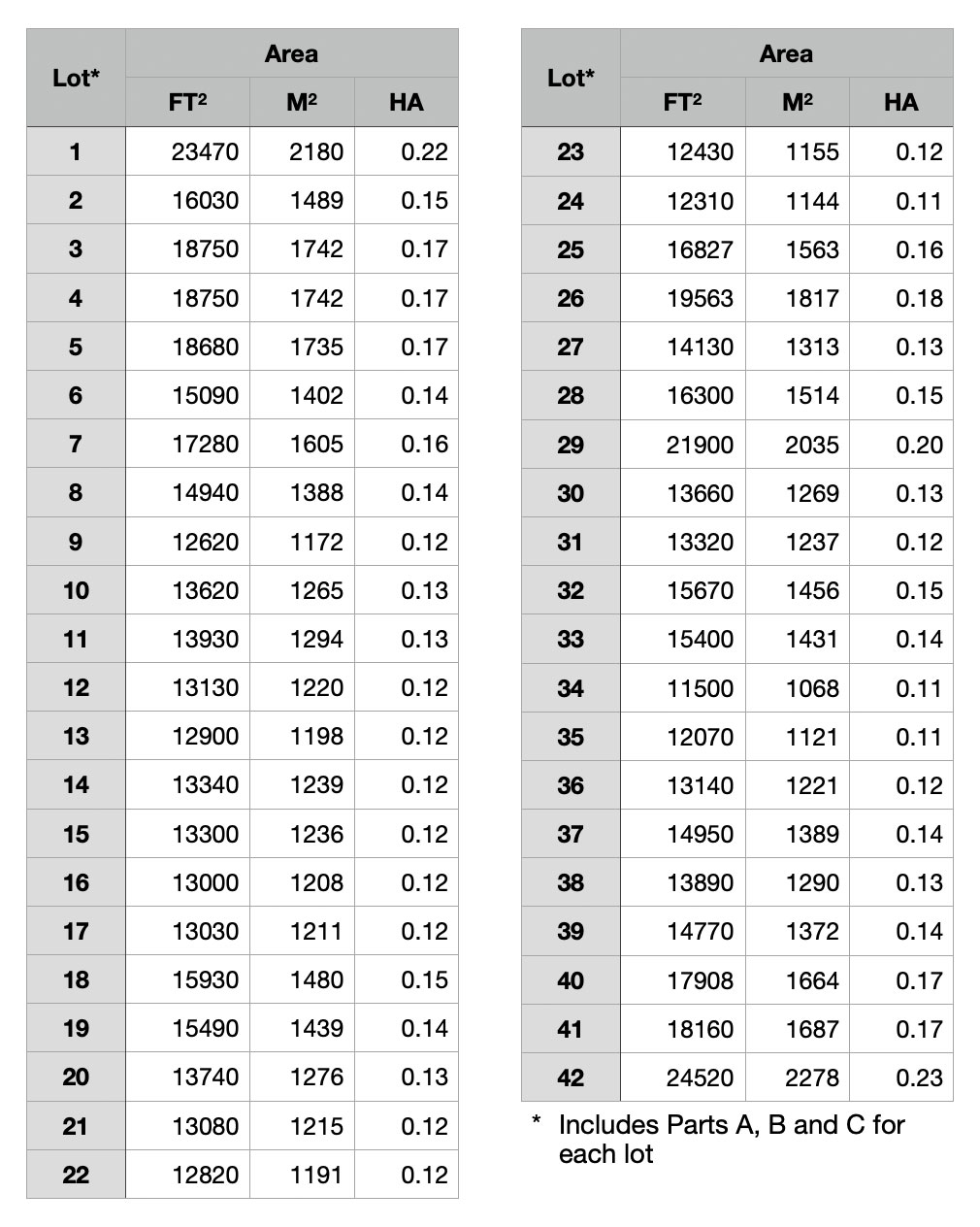
    3. Tuttle Point has an average of 0.18 ha/lot. The largest lot is approximately 0.28 ha, the smallest approximately 0.11 ha.
  3. With the reduction in the number of lots, the RLS zone becomes increasingly an artifact of history where access to mainly smaller waterfront properties was provided by private roads. The general prohibition of new private roads means that there will be few if any new RLS lots. Zoning considerations for future growth become secondary to the fact that the RLS zone is an exceptional situation justifying a smaller minimum lot size. Setting this minimum to 0.4 ha would:
    1. be consistent with the R1 and RH zones;
    2. limit the potential for land division through consent (severance) to only a handful of lots
    3. support setting minimum yard and maximum lot coverage more consistent with the existing RLS lot areas (see discussion below); and
    4. change a number of lots from non-compliant to compliant for lot area.
  4. Linking the minimum lot area to a registered plan is likely too difficult an option for the majority of RLS lots. However, all Tuttle Point lots are included in one reference plan (15R-118). This document could be considered for defining Tuttle Point minimum lot areas and frontages.
  1. Reduce the minimum lot area to 0.4 ha.
  2. Consider linking the minimum lot area for Tuttle Point lots to Reference Plan 15R-118
RLS 9
Minimum Frontage
  1. Many lots in the new RLS zones have less than 30 m frontage. Few have 45 m or greater frontage.
  2. The 45 m minimum frontage would make certain conforming lots non-conforming and has no apparent benefit.
  3. Unless there is a compelling reason, the minimum frontage should not be increased.
  1. Retain the 30 m frontage.
RLS 10
Minimum YARDS
  1. Yard means an open, uncovered area associated with a building or structure. The yard requirements specify the setback of the building or structure from the lot lines.
  2. This table compares the current and proposed yard minimums for the RLS zone and the two residential zones most similar to RLS.
  3. For RLS, the draft by-law proposes reducing the front, exterior side and rear yards and increase the interior-side yard. The following comments are offered.
    1. The reduction of the front, exterior side and rears yards will improve flexibility in lot use and should be supported, but does the RLS zone require greater front and exterior-side yards than the R1 and RH zones? As a minimum the Community Development Committee should explain the rationale for these differences as part of the public review process.
    2. The proposed doubling of the interior side yard from 3 m to 6 m is problematic. For many narrow lots, a 6 m side yard could severely limit building options. Existing buildings or structures could become non-conforming, possibly preventing enlargement or extension without permission from the Committee of Adjustment.
    3. An interior side yard of 3 m is being proposed for both R1 and RH zones. Why the increase for RLS? Without an answer, how will requests for a minor variance be adjudicated?
  4. NOTE Since the majority of the proposed RLS lots are water front, the setback provisions of draft by-law section 3.5 will apply. See "Water Frontage and Water Setbacks" below.
  1. Set the yard minimums to the same as for the R1, with private services, and RH zones.
RLS 11
maximum building height
  1. The proposed reduction of maximum building height from 11 m to 10 m applies to single dwellings in all residential zones.
  2. The draft bylaw proposes reducing the maximum height for accessory buildings from 6 m to 5.5 m in section 3.1.
  3. No rationale is provided for either of these increased restrictions.
  1. To permit further review, request the Township provide rationale for the proposed changes.
RLS 12
maximum lot coverage & FLOOR SPACE INDEX
  1. The draft bylaw defines lot coverage as "that portion of the area of a lot covered by all main and accessory buildings, porches, decks, swimming pools and similar features, but excluding automobile service station pump island canopies, entrance canopies for non-residential buildings, and balconies and overhanging eaves which are more than 2.5 m above finished grade." (emphasis added)
  2. The halving of the maximum lot coverage from 20% to 10% is problematic, not only because of the absolute reduction but also because swimming pools are added to the list of structures used to calculate lot coverage. The current by-law permits open private swimming pools "to cover up to 15% of a lot in addition to the maximum lot coverage provisions of the corresponding zone".
  3. Under the proposed limit, the average lot in the new RLS zone would have maximum coverage of about 280 m2 (≈ 3000 ft2). For Tuttle Point the average maximum coverage would be 180 m2 (≈ 1950 ft2) and for many properties, the allowable coverage would be considerably less. (Approximate lot sizes for individual Tuttle Point lots are listed in this table.)
  4. As shown in the zoning comparison table, the proposed maximum lot coverage for RLS differs from the R1 and RH zones, both of which have 30% maximum lot coverage over smaller minimum lot areas.
  5. The proposed "Floor Space Index" adds an additional restriction on dwelling size by limiting "the ratio of the total floor area of a dwelling ... to the area of the lot." (definition of Floor Space Index, draft bylaw p. 9) Compounding this limit is the proposal that unfinished basements or cellars greater than 6.9 ft in height be included in the total floor area. (definition of Floor Area, draft bylaw p. 9) The floor space index restriction has been applied only to RLS zones.
  6. Singling out the RLS zone for new and aggressive restrictions on lot coverage and dwelling size is not justified. While limiting lot coverage in rural areas may be supported from an aesthetic perspective, the impact of the new rules on RLS properties and their owners will be significant, considering actual lot sizes.
  7. In consideration of the rural nature of the RLS zones, the existing 20% maximum lot coverage may be more appropriate than the 30% for the R1 and RH zones located primarily in settlement areas. On the other hand, the size of the new RLS zones and the compact nature of these established neighbourhoods means that development on these properties should have a trivial effect on the rural character of the Township.
  8. The floor space index is a means of controlling building density by limiting the total size of a structure in a given area. Setting a maximum building size has both aesthetic and practical effects. For example, it can prevent overly large buildings in an area of mainly smaller buildings or it could reduce the shadowing of other properties. However, what effects this restriction is attempting to achieve in RLS zones are not clear. It does have the negative effect of making some existing dwellings non-compliant. Unless there are compelling reasons, the floor space index should be removed from the draft by-law.
  1. Retain, as a minimum, the 20% maximum lot coverage.
  2. Remove uncovered outdoor swimming pools from basic lot coverage unless there is a compelling reason for this restriction. (See comment above)
  3. Remove the "Floor Space Index".

General Provisions and Uses

Accessory Uses, Buildings and Structures

Accessory Uses

"Uses" in this context means the purpose for which a lot or structure is designed, arranged, occupied or maintained. Most uses are described in the definition section of both the current by-law and the draft by-law. Provisions specific to certain uses are described in Section 4 in both documents. Per the definition, at right, accessory uses refers to those other than the main or principal use of the property.

The zone provisions in the by-laws specify permitted uses. The current by-law lists all uses applicable to the zone, both principal and accessory. It can be unclear whether a use is a main use or not. For example could a "Tot Lot" be a main use in an RLS zone?

The draft by-law is more specific in specifying the main use or uses for each zone. All other uses are by definition accessory for that zone. Restrictions on accessory uses are listed in the descriptions in Section 4.

Table 5 describes certain changes in uses potentially affecting the RLS zone. With one exception these are presented as information, with no comment, as they will affect each property owner in an individual manner.

Definition of Accessory (from Zoning By-Law)

Accessory when used to describe a use, building or structure, means a use, building or structure naturally or normally incidental, subordinate and exclusively devoted to a main use, building or structure and located on the same lot therewith, but does not include a building or structure used for human habitation. Examples of accessory buildings or structures are a detached garage, a storage shed or a swimming pool. Examples of accessory uses are a home based business, an apartment above a store, or a retail outlet within a manufacturing plant.

Table 5 - Selected Uses - changes proposed
Use Change from Current By-Law Applicability to RLS
Bed and Breakfast Establishment
  1. Definition changes from a "private dwelling designed to be used as..." to "a business conducted in a single dwelling...".
  2. All zone specific restrictions removed are from the zone provisions.
  3. The RLS zone is totally prohibited from bed and breakfast use. The current by-law permits a bed and breakfast if the property fronts on a public road that is maintained year round.
Not permitted.
Cannabis Production and Processing Facilities New use Not permitted
Group Homes
  1. More complete definition. Removes requirement for provincial licensing or approval.
  2. Removes minimum distance between group homes.
Permitted
Home Based Business
  1. Several changes to definitions and regulations for home based businesses which may be applicable to those considering or operating such a business
  2. The requirement that a home based business be on a public road is removed.
Permitted
Second Dwellings or Second Dwelling Units
  1. The RLS zone no longer allows second dwelling units, presumably because no RLS lot is expected to front on a public road.
  2. Although the draft RLS zone specifically prohibits secondary dwelling or dwelling units, section 4.8 states that "Notwithstanding any provision of this By-law to the contrary, where a single dwelling... is permitted as a principal use in a zone... a second dwelling unit or second dwelling... is permitted" subject to restrictions. This inconsistency should be resolved..
Not permitted
(to be confirmed)
Tiny Homes New use Permitted as a single dwelling
Tot Lots Removed from the by-law Unknown

Accessory Building and Structures

Various sections of both the current and draft by-laws specify requirements for accessory buildings and structures. Table 6 summarizes provisions in both documents. Table 7 discusses certain changes.

TABLE 6 - ACCESSORY BUILDINGS AND STRUCTURES - Changes to provisions

The numbers in brackets indicate the applicable section in the current or draft by-law.

Provision Current By-Law Draft By-Law (Oct) Comment
Maximum Lot Coverage
  • 100 m2 - Garage (4.28)
  • 55 m2 - Boathouse (4.3)
  • Swimming Pools not included in total (4.1(g))
  • 10% total for all accessory buildings and structures (3.1)
  • Swimming Pools included in total (LOT COVERAGE definition)
ABS 1
Maximum Height (RLS Zone)
  • 6 m (6.4)
  • 4 m Boathouse (4.3)
5.5 m (3.1) ABS 2
# Stories Unspecified 1 (3.1)
Separation Between Buildings 2 m 1 m (3.1)  
Marine Facility to Adjacent Lot Line 3 m (4.1) 4.5 m (3.1)  
table 7 - Accessory Buildings and Structures - Comments
SER COMMENTS RECOMMENDATONS
ABS 1
Maximum Lot coverage
  1. Although the specific size restrictions on garages and boat houses are removed, the 10% maximum lot coverage is new. The practical affect of this is unclear with respect to the majority of RLS lots in the new zones.
  2. Adding swimming pools, which by definition are accessory structures, to the total coverage calculation, reduces the lot coverage area available for other accessory buildings and structures.
  1. The Community Development Committee should explain the rationale for including swimming pools in lot area calculations and the aesthetic and practical objectives of the proposed limit.
ABS 2
Maximum height and Stories
  1. Although the practical effect of reducing the maximum height for most accessory buildings is uncertain, the need is not clear and should be explained.
  2. The rationale for limiting accessory buildings to one storey should also be explained.
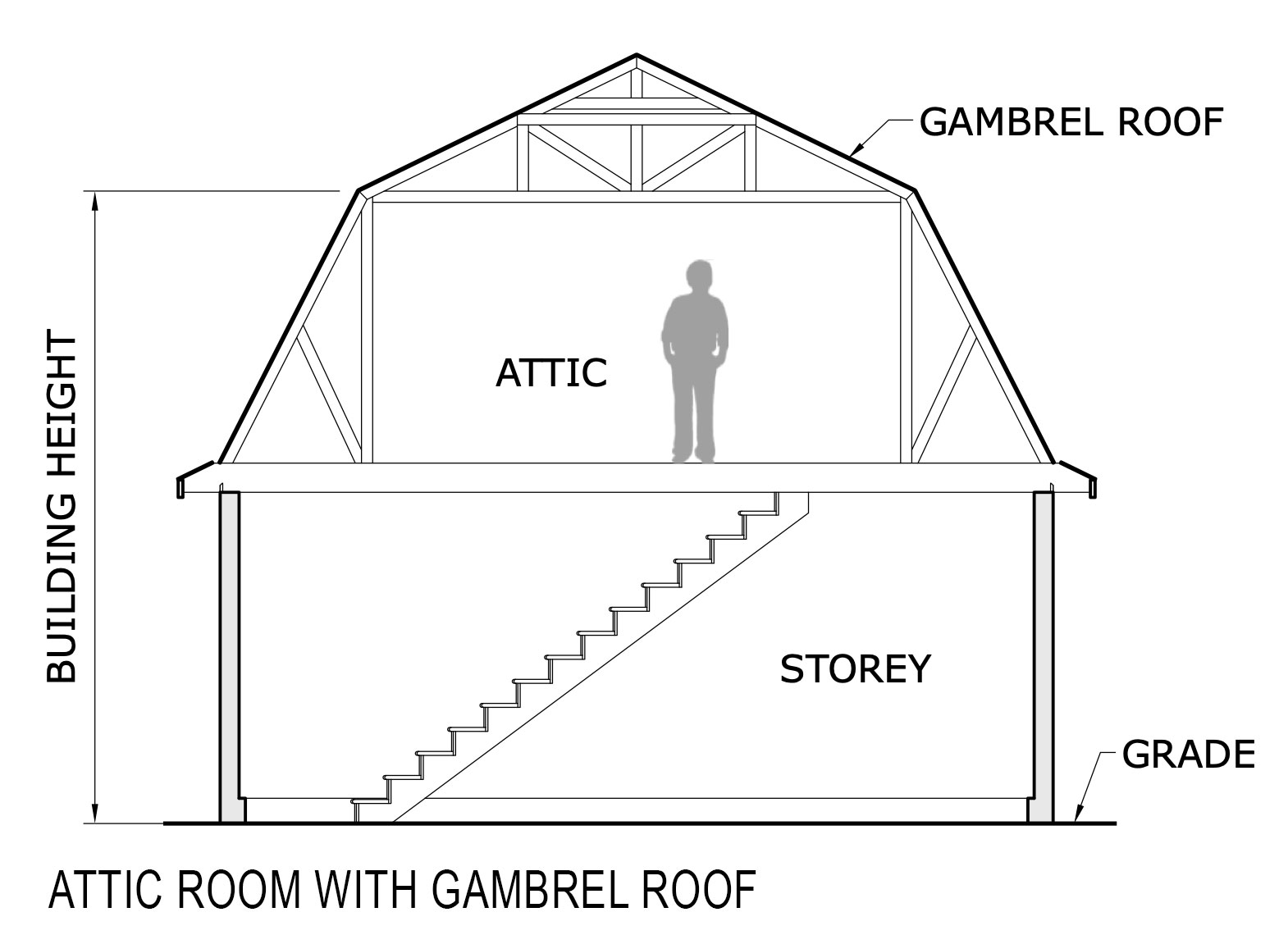
  3. Storey as defined in the draft by-law does not include a cellar, basement or attic. Attic is not defined in the proposed by-law. The current by-law defines attic as "that portion of a building immediately below the roof and wholly or partly within the roof framing". Under this definition the configurations shown in the figures below could be considered attics. For clarity attic should be defined in the new by-law.
  1. The Community Development Committee should describe the rationale for reducing maximum height and limiting buildings to one storey.
  2. The zoning by-law should retain the current definition of attic.
Garage No Dormer Garage Dormer Garage Gabrel

Non-Conforming Uses and Non-Complying Uses, Buildings and Structures

  1. Provisions regarding non-conformance and non-compliance regulate the vesting of variances that were legally created prior to the enactment of a new by-law. They also provide direction on changes permissible without a zoning change or a minor variance.
  2. These provisions are contained in section 4.26 of the current by-law and sections 3.2 and 3.11 of the draft by-law. The draft by-law differs from the current by-law as follows:
    1. The definitions of "non-conforming" and "non-complying" more clearly link conformance with permitted uses and compliance with by-law provisions other than permitted uses.
    2. Buildings accessory to an existing non-conforming use are allowed providing they are compliant.
    3. The existing section on "Less than Minimum Yard Requirement" (4.2 (g)) has been replaced with the more general section (3.11.6) "Enlargement of Non-Complying Uses, Buildings or Structures". An issue with this change is discussed in table 8.
table 8 - Enlargement of Non-Complying Uses, Buildings or Structures
SER COMMENTS RECOMMENDATONS
NCU 1
Non-complying minimum yards
  1. The current by-law allows for the enlargement of buildings or structures that do not comply with minimum front, side or rear yards providing that the enlargement does not further reduce the non-compliant yard(s) and other provisions of the by-law are met. The draft by-law appears to remove this automatic vesting. It states that such buildings or structures shall not be enlarged, except in compliance with all applicable provisions of the by-law.
  2. Many of the older buildings on Tuttle Point are non-compliant with at least one minimum yard. The current provision is important in that it supports improvement or replacement of these buildings without recourse to the minor variance process.
  1. The exception for existing non-compliance with minimum front, side and rear yards should be retained

Shoreline Area Occupancy

  1. Section 3.20 of the draft by-law states, "Notwithstanding any provisions of this By-law to the contrary, on any lot abutting a water body and used for purposes other than a marina, a maximum of 20% or 15 m of the shoreline area, whichever is lesser, shall be occupied by marine facilities, pump houses, stairs, decks, patios, gazebos and all other accessory buildings and structures. For the purposes of this section, the shoreline area shall include that portion of the lot lying within 3 m of the high water mark."
  2. This appears to be a new restriction. It is highlighted here for information.

Water Setback

  1. Both the current by-law, section 4.37(c), and the draft by-law, section 3.25, establish the minimum setback for above and below ground buildings and other structures from the high water mark as 30 m. Similar water setback minimums are common in Ontario zoning by-laws. The Township Official Plan, section 6.18 states the "intent of the water setback is to prevent the disturbance of the shoreline area as a result of the placement of buildings and structures... or the removal of the solid mantle and natural vegetation.
  2. Structure is defined as "anything constructed or erected, the use of which requires location on the ground or attached to something having its location on the ground...". A building is a specific class of structure. In addition to buildings, examples of structures include swimming pools, decks, gazebos, sewage treatment systems, etc.
  3. Relief from the water setback is provided for certain water use related structures such as boat houses and launches, docks, pump houses, etc. subject to approval by the applicable conservation or environmental authority.
  4. Although the minimum water setback has been in effect for many years, there are issues related to the RLS zones and particularly Tuttle Point that should be addressed in the new zoning by-law. These are discussed in Table 9.
table 9 - minimum water setback
SER COMMENTS RECOMMENDATONS
MWS 1
Minimum Water setback - Affect on Existing Lots
  1. As shown in the proposed zoning maps, development on many RLS lots is severely limited by the 30 m water setback. This is particularly so for Tuttle Point. Surrounded by water, little of Tuttle Point is outside the 30 m setback and many lots have no area clear.
  2. Tuttle Point 30m Water SetbackClick to enlarge

  3. Compliance with the following provisions will be difficult if not impossible for lots on Tuttle Point:
    1. Replacement of Sewage Disposal Systems The draft by-law, section 3.11, provides that replacement shall be "such that the minimum water setback is the setback of the existing sewage disposal system or as set out in the Ontario Building Code, whichever is greater". This is problematic because:
      1. Replacement of a holding tank with a leaching bed and the somewhat more stringent design requirements for modern sewage treatment systems mean that many if not all replacement systems will need to further encroach into the water setback.
      2. One lot (#40) has no existing sewage system and no area outside the 30 m water setback.
    2. Enlargement of Existing Structures Few non-marine structures and none of the residences on Tuttle Point comply with the water setback. Section 6.11.6 of the proposed by-law requires that enlargement of these structures must comply with all provisions of the zoning by-law. With respect to the water setback, this is likely impossible for most structures.
    3. New Structures There is limited to no space on most lots for new structures that do not encroach into the water setback
    4. Yard and Water Setback Encroachments Section 3.27 provides water setback relief for certain structures. Most of the allowable encroachments cannot be met on Tuttle Point.
  4. Although the Committee of Adjustment can permit a minor variance of the water setback on a case-by-case basis, more general relief is recommended. An exception for Tuttle Point would:
    1. apply to a large number of properties;
    2. ensure that all properties are treated equally;
    3. reduce the potential cost and planning time for owners developing their property;
    4. reduce the potential workload of the Township staff and the Committee of Adjustment; and
    5. recognize that the non-compliance may not be minor (i.e. less than the 25% difference to the zoning standard mentioned in the note to section 2.4 of the current by-law).
  5. General relief from the water setback should not conflict with achieving the primary objective of the setback to protect the shoreline. In fact, development may be beneficial on Tuttle Point.
  6. There is little that is natural about the Tuttle Point waterfront. Most of the point is man made, the south shore is mainly comprised of a concrete wall along the North Channel canal, the part of Drummond Island forming the western tip is buried in soil removed during the excavation of the canal, and the waterfront has been repeatedly disturbed over the decades by excavation and fill and by changing use from pasture to orchard to recreational to residential. Much of the early development was likely completed with no permit or reference to environmental concerns.
  7. Future development regulated by the Conservation Authority, the sewage system permitting and inspection authority and the Ontario Building Code will only serve to improve the erosion resistance of the waterfront, remove inappropriate fill, restore crumbling structures, reduce potential sewage system pollution and protect the wetlands.
  1. The revised zoning by-law should provide an exception to the water setback provision for Tuttle Point (Plan 15R-118).

Recreational Vehicles

  1. The current by-law defines recreational vehicles as mobile short-term accommodation for humans, including motor homes, travel trailers, tent trailers, campers and boats but not mobile homes or manufactured homes. There is no definition of recreational vehicle in the draft by-law.
  2. Neither the current or draft by-laws consider a recreational vehicle as a dwelling.
  3. The principal changes of the provisions regarding recreational vehicles are described in table 10.
table 10 - Recreational Vehicles - Proposed Changes
SER COMMENTS RECOMMENDATONS
RV 1
Seasonal or Temporary Use
  1. The current by-law, section 4.32 (c), forbids the use of a recreational vehicle as a seasonal dwelling on vacant lots. There is no reference to their seasonal use as accommodation on occupied lots. The length of a "season" is not specified.
  2. The draft by-law, section 3.12.3 is more restrictive and prohibits, for the purpose of human habituation, any "recreational vehicle, travel trailer or tent trailer, except in a tourist campground or as a temporary use in accordance with Section 3.22 of this By-law." (Section 3.22 deals with temporary use during construction and is discussed below.)
  3. The prohibition of the long-term occupancy of a recreation vehicle outside of campgrounds is logical given the uncertain availability of sewage handling facilities and the potential for such use to become a second dwelling. However, short term occupancy may be acceptable. Accommodation of guests or temporary use by a visitor with a recreational vehicle are examples. Considerations such as traffic, seasonal population growth, noise, the maximum length of occupancy, etc. need to be addressed. Other Ontario municipalities have attempted to address the issue by licensing temporary use and setting cumulative or sequential limits on occupancy, for example.
  4. The issue of temporary recreational vehicle occupancy has received considerable discussion in the Township, particularly on Tuttle Point. Both short term occupancy and seasonal occupancy have proponents, but no consensus has been established. It is recommended that the Community Development Committee examine best practices from other municipalities and specifically solicit public input on this issue as part of the by-law review process.
  1. With respect to recreational vehicles, the Community Development Committee should:
    1. investigate the best practices in Ontario municipalities regarding the temporary occupancy; and
    2. solicit specific public input.
RV 2
Use During Construction
  1. Both the current by-law, section 4.39, and the draft by-law, section 3.22, permit temporary occupancy of a recreational vehicle during construction for which a building permit is current and until the work is completed or abandoned. The draft by-law is more restrictive, with the following additional provisions:
    1. a temporary connection to an approved on-site sewage disposal system is to be provided;
    2. the recreational vehicle must be located in accordance with the required yards and water setbacks applicable to a dwelling; and
    3. the use is limited to two years.
  2. With the exception of the two year limit, the new provisions are overly restrictive, particularly for RLS lots:
    1. The sewage disposal system is often the last structure added during construction of a dwelling, meaning that the temporary accommodation could not be utilized during a significant portion of the building time.
    2. Limiting the location of the recreation vehicle to within the required yard and water setbacks reduces the flexibility of a location that avoids conflict with the construction process.
  3. The objectives of the sewage disposal and siting restrictions could likely be met through a permitting process that specified the objectives and evaluated the proposed solutions during permit application review.
  1. The new by-law should:
    1. specify the sewage handling and siting objectives for temporary occupancy of recreational vehicles during construction; and
    2. specify a permitting process, including fees, for temporary occupancy.
×

RLS Zone Lot Areas (Draft By-law)

RLS Zone Lot Areas

(The areas shown are based on the Leeds Grenville Property Lookup GIS website and its measurement tools.)

×

Settlement Policy Area

Settlement Area policies apply to the Township’s villages and hamlets, which include the Urban Settlement Area of Cardinal, as well as the Rural Settlement Areas of Brouseville, Groveton, Hyndman, Johnstown, New Wexford, Shanly, Spencerville, Pittston, and Ventnor (Official Plan section 3.1)

×

Zone Requirement Comparison

Zone Requirement Table
* The minimum lot area may be reduced to 4000 m2 (0.4 ha) if the lot can be serviced by a sustainable private sewage system.

Increased restrictions are highlighted in red.
Reduced restrictions are highlighted in green

×

Tuttle Point Property Area by Lot

Zone Requirement Table

The areas shown are from Reference Plan 15R-118 dated 30 July 1971. Based on recent surveys of specific properties, these may be smaller than the current actual lot sizes, but they are good approximations.

×

Tuttle Point Water Setback

Water Setback

This diagram is based on Reference Plan 15R-118 dated 30 July 1971. The waters edge shown is approximate and does not reflect subsequent development of certain lots.

The "original shore line" existed before the creation of the North Channel Canal. Much of Tuttle Point is "made land", created from the material removed during excavation and deepening of the canal. The western end of the Point is mainly comprised of a portion of Drummond Island.

×

Zoning By-Law Table of Contents Comparison

Zoning By-Law 2012-35 Zoning By-Law DRAFT (2020-10)
Section Title Section Title
1 Administration 1 Application and Interpretation
2 Conformity Requirements 2 Definitions
3 Definitions 3 General Provisions
4 General Provisions 4 Specific Use Provisions
5 Zones 5 Zones
6 Residential Zones 6 Residential Zones
7 Commercial Zones 7 Village Core Zones
8 Industrial Zones 8 Commercial Zones
9 Institutional Zones 9 Industrial Zones
10 Rural Zones 10 Institutional Zones
  11 Open Space Zones
  12 Rural Zones
  13 Agricultural Zones
  14 Mineral Resource Zones
  15 Environmental Protection Zones
SCHEDULES SCHEDULES
A Township Interior A Township of Edwardsburgh-Cardinal
B Cardinal and Area B Village of Cardinal
C Spencerville and Area C Village of Spencerville
D Waterfront West D Village of Johnstown
×

Edwardsburgh Cardinal Vision and Guiding Principles

Vision

We will preserve and enhance our Township’s unique character, scenic rural landscapes, vibrant communities and valued natural heritage as we move towards a future of balanced and sustainable growth and improved quality of life for all residents of Edwardsburgh Cardinal.

Guiding Principles
  1. We will ensure that growth and development occurs through sustainable and economically viable land use development patterns.
  2. We will ensure that development in our communities will include a broad range of uses and a balanced mix of appropriate residential densities.
  3. We will support waterfront development having regard to public spaces, recreation and access including interconnected facilities through the development of pathways and parklands.
  4. We will continue to focus on our Industrial Park as an economic centre and actively seek out new opportunities for trade and development in a future expanded Industrial Park Policy Area.
  5. We are committed to increasing the number and diversity of employment opportunities by promoting our industrial properties and the introduction of a mixed employment uses approach to encourage business clusters and varied economic activities in our employment areas.
  6. We are committed to the preservation of our cultural heritage including historical connections to the Rivers, the traditional thoroughfares of the waterways, the Galop Canal, archaeological sites, cemeteries and burials, buildings and structural remains of historical and architectural value, and human-made rural, village, and urban districts or landscapes of historic interest.
  7. We will protect our natural environment.
  8. We will ensure public involvement in the planning process to ensure the protection of everyone’s property rights.
  9. We will continue to protect and value our agricultural lands.
  10. We value energy efficiency and will guide development to ensure long-term energy sustainability and self-sufficiency.
×

Definition of Marine Facility

Definition of Marine Facility

The definition reflects the change between the draft zoning by-law and the current by-law.